
Mastering Sub-Zero Logistics: Your Complete Guide to Freezer Transport in the UAE
When your cargo requires temperatures below -18°C, standard refrigeration is insufficient. You enter the domain of deep freeze logistics—a science where precision engineering meets rigorous operational discipline. At Chiller Vans For Rental, we specialize in freezer van rental and freezer truck rental solutions engineered specifically for the UAE’s extreme climate challenges. Whether you’re distributing premium ice cream across Dubai’s hotels, exporting frozen seafood through Jebel Ali Port, or transporting high-value pharmaceutical products requiring ultra-low temperatures, our fleet provides the guaranteed thermal integrity that protects product quality, safety, and commercial value from loading dock to final destination.
The difference between chilled and frozen transport is not merely temperature, it’s an entirely different operational paradigm. While chilled transport focuses on maintaining +2°C to +8°C, freezer transport must combat phase change physics, manage defrost cycles, and prevent thermal shock. This guide explores the specialized technology, protocols, and vehicle specifications that make our freezer transport service the definitive solution for businesses that cannot compromise on sub-zero integrity. We also provide a dedicated freezer truck for rental in Dubai to handle large-scale sub-zero deliveries.
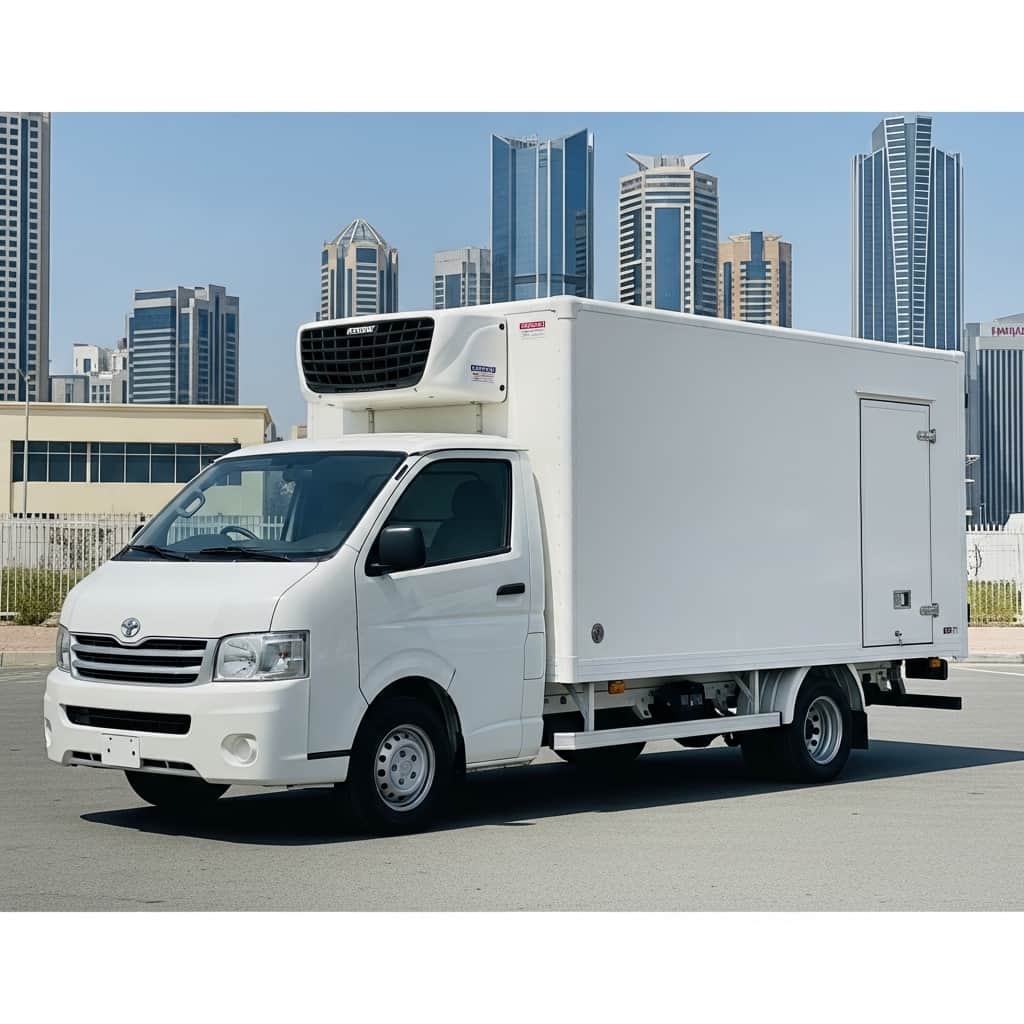
Technical Specifications: Our Deep Freeze Fleet Architecture
Our freezer van vehicles are engineered with layered protection systems, from advanced insulation to multi-stage refrigeration.
| Specification Category | 1-Ton Freezer Van | 3-Ton Freezer Van | 7-Ton Freezer Truck | Critical Performance Factor |
|---|---|---|---|---|
| Base Model | Toyota Hiace Deep-Freeze | Mercedes Sprinter Freezer | Isuzu FVR Freezer Truck | Chassis reliability under constant heavy cooling load |
| Temperature Range | -18°C to -22°C | -20°C to -25°C | -22°C to -30°C | Ultra-low temperature capability for specialized cargo |
| Pull-Down Performance | Ambient to -20°C in 45 mins | Ambient to -22°C in 60 mins | Ambient to -25°C in 90 mins | Critical for loading non-prechilled products |
| Insulation System | 80mm PU foam + vapor barrier | 100mm PU foam + thermal break | 120mm VIP panels + thermal break | R-value determines heat ingress rate |
| Refrigeration Capacity | 5,000 kcal/hr @ -20°C | 9,000 kcal/hr @ -25°C | 18,000 kcal/hr @ -30°C | Cooling power at target temperature (not maximum) |
| Defrost Management | Automatic hot gas defrost | Hot gas + electric defrost | Multi-stage adaptive defrost | Prevents ice buildup on evaporator coils |
| Temperature Uniformity | ±2°C across cargo area | ±1.5°C across cargo area | ±1°C across cargo area | Prevents partial thawing in specific zones |
| Monitoring System | Dual sensors + data logger | Triple sensors + cloud logging | Multi-zone monitoring + satellite | Redundancy ensures no data loss |
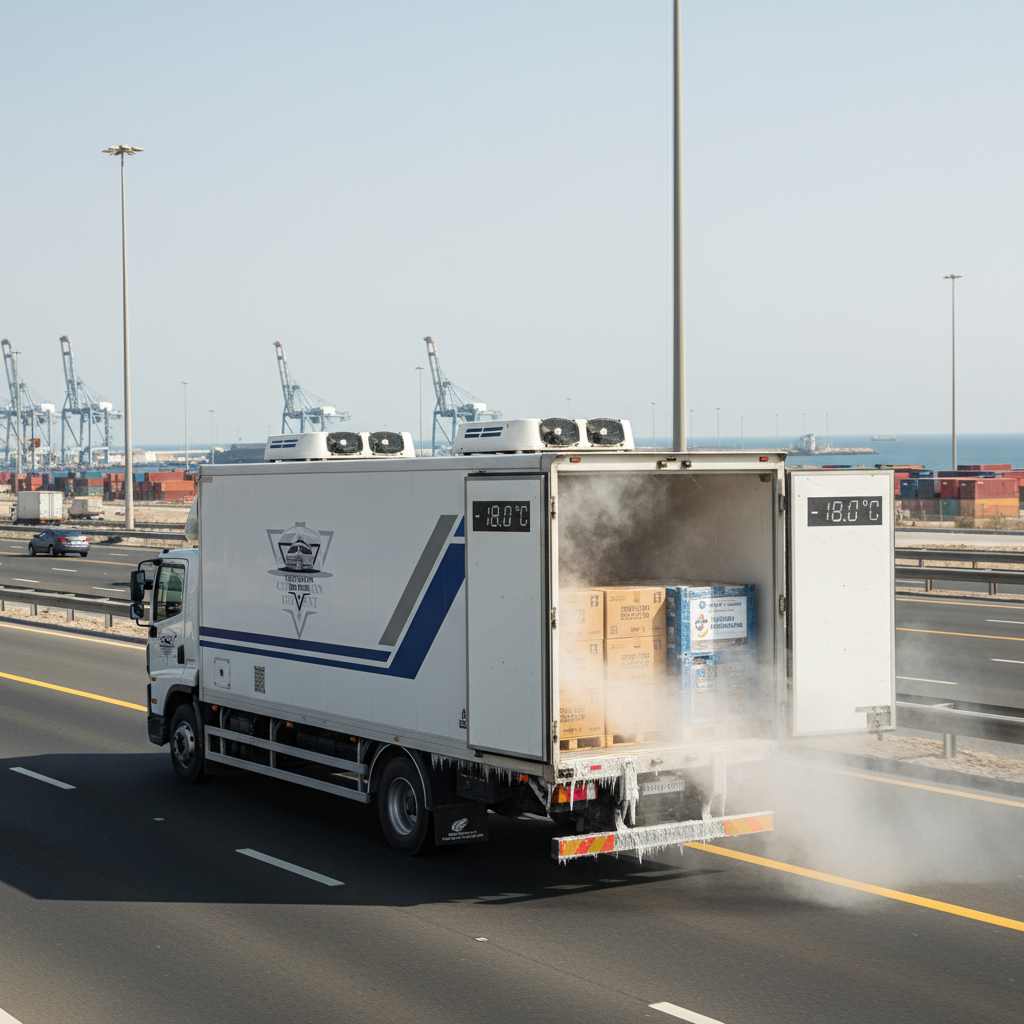
Your Next Step: Implementing Reliable Freezer Logistics
Don’t risk your frozen products to inadequate transportation. Our freezer transport specialists provide:
- Needs Assessment: Analyze your specific temperature requirements
- Vehicle Specification: Match the right freezer vehicle to your cargo
- Protocol Development: Create customized loading and transport procedures
- Compliance Setup: Ensure all regulatory requirements are met
- Performance Monitoring: Continuous improvement of your cold chain
The Physics of Frozen Transport: Critical Considerations
1. Thermal Mass vs. Cooling Capacity
Frozen goods have significant thermal mass. When loading at -18°C into a +45°C UAE environment, the refrigeration system must overcome:
- Conductive heat gainthrough insulation
- Radiant heat gainfrom sun exposure
- Convective heat gainduring door openings
- Product heat loadfrom warmer items
Calculation Example:
Loading 500kg of ice cream at -18°C into a +45°C environment requires removing approximately 15,000 kcal of heat. Our 3-ton freezer van’s 9,000 kcal/hr capacity handles this in under 2 hours while maintaining cargo integrity.
2. Defrost Cycle Management
All freezer systems require periodic defrosting to remove ice from evaporator coils. Poor defrost management causes:
- Temperature spikes during defrost cycles
- Reduced cooling efficiency
- Compressor strain and failure
Our Solution: Adaptive defrost systems that:
- Monitor coil ice accumulation
- Schedule defrosts during transit (not stationary)
- Use hot gas from compressor (not electric heaters)
- Limit temperature rise to <3°C during defrost
Industry-Specific Applications & Protocols
Ice Cream & Frozen Dessert Distribution
Critical Challenge: Preventing “heat shock” that causes ice crystal formation and texture degradation.
Our Specialized Protocol:
- Pre-cooling: Vehicles cooled to -22°C (4°C below transport temperature) before loading
- Loading Window: Maximum 15-minute door opening with air curtain engaged
- Transport Temperature: Maintained at -18°C to -20°C with ±1°C tolerance
- Delivery Sequence: Last-in, first-out routing to minimize door openings
Recommended Vehicle: 3-Ton Freezer Van with rapid temperature recovery
Seafood & Frozen Protein Transport
Critical Challenge: Maintaining consistent temperatures to prevent bacterial growth and quality degradation.
Our Specialized Protocol:
- Sanitization: Food-grade sanitization between loads
- Temperature Monitoring: Continuous monitoring with 5-minute intervals
- Loading Configuration: Air flow channels maintained around all pallets
- Documentation: Catch certificates and temperature logs provided
Recommended Vehicle: 7-Ton Freezer Truck with separate compartments for different product types
Pharmaceutical & Biotech Products
Critical Challenge: Maintaining ultra-low temperatures (-25°C to -30°C) for vaccines, biologics, and clinical samples.
Our Specialized Protocol:
- GDP Compliance: Validated equipment with qualification documents
- Backup Systems: Dual compressors + battery backup for monitoring
- Security: Tamper-evident seals and GPS tracking
- Documentation: Complete chain of custody with digital signatures
Recommended Vehicle: GDP-Validated 7-Ton Freezer Truck with -30°C capability
Cost Analysis: Freezer vs. Chiller Transport Economics
| Cost Component | 3-Ton Chiller Van | 3-Ton Freezer Van | Premium for Freezer | Justification |
|---|---|---|---|---|
| Daily Rental Rate | AED 350-450 | AED 450-550 | +25% | Heavy-duty compressor, advanced insulation, dual monitoring |
| Fuel Consumption | 7-9 km/liter | 6-8 km/liter | +15% | Higher compressor workload maintaining sub-zero temps |
| Maintenance Costs | Standard service | Enhanced service | +30% | Specialized refrigerant handling, defrost system maintenance |
| Insurance Premium | Standard cargo | Enhanced cargo | +20% | Higher value frozen cargo, specialized coverage |
| Total Cost Increase | Baseline | +22-25% | Worthwhile Investment | Prevents total cargo loss (typically 100x rental cost) |
Operational Excellence: Loading & Transport Protocols
A Dubai ice cream distributor loses one pallet (AED 8,000 value) monthly due to temperature issues. Our freezer van premium (AED 100/day × 25 days = AED 2,500) prevents AED 8,000 loss, generating AED 5,500 monthly net benefit
Pre-Transport Checklist
- Vehicle pre-cooled to 4°C below target temperature
- Temperature monitoring system calibrated and active
- Door seals inspected for integrity
- Defrost cycle completed before loading
- Loading equipment sanitized and chilled
Loading Procedure
- Stage 1: Load furthest items first, maintaining air channels
- Stage 2: Close door for 10-minute cooldown after 50% loaded
- Stage 3: Complete loading with air curtain operational
- Stage 4: Verify temperature recovery before departure
In-Transit Monitoring
- Temp-Controlled Trucking
- Door opening log maintained
- GPS tracking with geofencing alerts
- Remote monitoring by our control center
Emergency Response Protocols
| Scenario | Immediate Action | Secondary Action | Time Critical |
|---|---|---|---|
| Temperature Rise >3°C | Document time/temp, check door seals | Move to shaded area, reduce door openings | <15 minutes |
| Compressor Failure | Activate backup if available, secure cargo | Dispatch replacement vehicle | <60 minutes |
| Power Failure (Electric) | Switch to diesel operation | Coordinate facility with power | <30 minutes |
| Road Accident | Secure scene, protect cargo temperature | Emergency cargo transfer | <90 minutes |
Frequently Asked Questions (FAQ)
Q1: What's the difference between a freezer van and a chiller van?
A: A chiller van maintains temperatures above freezing (+2°C to +8°C) for fresh goods. A freezer van maintains temperatures below freezing (-18°C to -30°C) for frozen products. The insulation, refrigeration capacity, and monitoring systems are fundamentally different.
Q2: How long can your freezer trucks maintain temperature during a power outage?
A: Our standard freezer trucks maintain temperature for 4-6 hours without power when fully loaded and properly sealed. Vehicles with VIP insulation can maintain for 8-12 hours. We recommend backup generator arrangements for longer outages.
Q3: Can you transport ice cream and frozen meat in the same vehicle?
A: Yes, with proper separation. We recommend dual-compartment freezer trucks that maintain different temperatures or complete physical separation to prevent cross-contamination. Standard protocol includes thorough sanitization between different product types.
Q4: What certifications do your freezer vehicles hold?
A: Our pharmaceutical freezer trucks are GDP-validated with full documentation. Our food transport vehicles comply with HACCP principles and Dubai Municipality/ADAFSA regulations. All vehicles have current calibration certificates for temperature monitoring.
Q5: How do you handle defrost cycles during long transports?
A: We use adaptive hot gas defrost systems that:
- Monitor evaporator coil temperature
- Initiate defrost only when necessary
- Use compressor heat (not electric heaters)
- Limit temperature rise to <3°C
- Schedule defrosts during highway transit (not during stationary periods)
Q6: What is the maximum ambient temperature your freezers can handle?
A: Our UAE-spec freezer vehicles are engineered to maintain -20°C in +50°C ambient temperatures. This requires 30-40% more cooling capacity than standard European or American specifications.
Q7: Can I rent a freezer vehicle for a single day for a special event?
A: Absolutely. We offer daily, weekly, and monthly rentals. Daily rentals are perfect for events, emergency coverage, or temporary capacity increases. Advance booking is recommended during peak seasons.
Q8: How do you prevent temperature spikes during loading?
A: Our protocol includes:
- Pre-cooling to 4°C below target temperature
- Using air curtains during loading
- Limiting door opening time
- Staging loads with cooling periods
- Training drivers in efficient loading techniques
Q9: What temperature monitoring do you provide?
A: We provide dual-sensor monitoring with:
- Real-time temperature display
- Data logging at 5-10 minute intervals
- Cloud-based access to temperature data
- Automated alert system for deviations
- PDF reports for compliance documentation
Q10: Do you offer temperature mapping services?
A: Yes. We offer professional temperature mapping services that:
- Place sensors throughout the cargo area
- Monitor under various load conditions
- Identify hot/cold spots
- Provide loading configuration recommendations
- Issue formal mapping certificates
Request a Free Frozen Transport Audit
Our specialists will analyze your current operations and provide a gap analysis with specific recommendations
Contact us today for a transparent quote and to book your vehicle.
- +971 54 595 3927
- info@chillervansforrental.com
- Available for Immediate Dispatch in Dubai & Abu Dhabi