
The Ultimate Guide to Cold Chain Logistics in the UAE 2026
Cold Chain Logistics UAE: The Complete 2026 Guide
In a country where the outside temperature routinely passes 45°C, keeping a product cold from the moment it’s made to the moment it’s used isn’t a nice-to-have — it’s the whole business. Cold chain logistics is the discipline that makes that possible, and in the UAE it’s tighter, hotter and less forgiving than almost anywhere else.
This guide explains what cold chain logistics UAE actually is, how the chain fits together, the temperatures different products need, where the chain tends to break in Gulf conditions, and how compliant refrigerated transport keeps it intact.
What is cold chain logistics?
Cold chain logistics UAE is the end-to-end management of temperature-sensitive goods — keeping them within a defined temperature range at every stage from production to final delivery. The “chain” metaphor is exact: it’s a series of connected links (storage, handling, transport, handover), and like any chain, it’s only as strong as its weakest point. One warm gap anywhere — a product left on a loading bay, a van that isn’t pre-cooled — can compromise everything that came before it.
The goods that depend on it fall into a few broad groups: fresh food (produce, dairy, meat, seafood), frozen food (ice cream, frozen meat, frozen ready-meals), pharmaceuticals (vaccines, insulin, biologics), and specialist cargo (flowers, chemicals, clinical samples). Each has its own temperature requirement and its own tolerance for error.
Why the UAE makes cold chain harder
Every principle of cold chain logistics UAE applies everywhere. What changes in the UAE is the margin for error, and it’s razor-thin.
- Ambient heat. A load left in an un-refrigerated vehicle can climb out of its safe band in minutes, not hours. There’s no “it’ll be fine for a bit.”
- Long, hot transit legs. Inter-emirate runs — Dubai to Abu Dhabi, Sharjah to the northern emirates — mean extended time in extreme heat and more stops.
- Humidity and door-opens. Every open door on a multi-drop run lets in hot, humid air the cooling unit then has to fight.
- High compliance expectations. Dubai Municipality, the DHA and HACCP-based food-safety rules set a firm bar, especially for food and pharma.
The upshot: cold chain logistics UAE equipment and practices that are “good enough” in a temperate climate simply aren’t in the Gulf. The system has to be built for the worst-case afternoon, not the average one.
The links in the chain
A complete cold chain logistics UAE has four core links. Transport is where most failures actually happen, but each matters.
- Cold storage. Chilled and frozen warehousing where product is held before and between movements.
- Handling and staging. Loading, unloading and the handovers in between — the moments when product is most exposed.
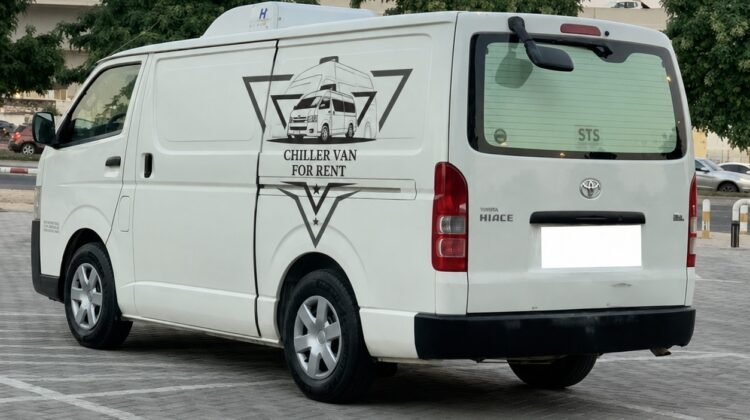
- Refrigerated transport. The moving link — chiller vans, freezer vans, adjustable refrigerated vans and reefer trucks that hold temperature on the road.
- Monitoring and documentation. Continuous temperature tracking and the records that prove the chain held — increasingly a requirement, not an extra.
Operator insight: the failure people expect is the vehicle; the failure we actually see most is the handover gap. Product sits on a sun-baked loading bay while paperwork is signed, and that unmonitored window is where the excursion happens. A strong cold chain logistics UAE closes that gap — pre-cooled vehicles, minimal staging time, and logging that starts at collection, not at departure.
Temperature bands by product
Different cargo lives in different bands. Getting this right is the foundation of everything else.
| Band | Range | Typical products |
|---|---|---|
| Deep freeze | −18°C to −25°C | Ice cream, frozen meat, seafood, frozen bakery |
| Chilled / fresh | +2°C to +8°C | Produce, dairy, fresh meat, chilled pharma |
| Controlled room temp (CRT) | +15°C to +25°C | Many medicines, tablets, some cosmetics |
| Frozen pharma | to −20°C | Certain biologics and frozen medical products |
For a deeper breakdown of the two most common bands and which vehicle serves each, see chiller van vs freezer van.
Where the cold chain breaks — and how to prevent it
Most cold-chain failures aren’t dramatic. They’re small, quiet gaps that add up. The common ones:
- Vehicles not pre-cooled. A van at cabin temperature pulls its cargo warm for the first 20–30 minutes. Fix: bring the box to temperature before loading.
- Overpacking. Cargo jammed wall-to-wall blocks airflow, so the middle of the load runs warmer than the unit’s reading. Fix: load with airflow channels.
- Too many door-opens. Each stop on a multi-drop run resets the recovery clock. Fix: sequence stops so the most heat-sensitive cargo comes off first and doors stay shut on the long legs.
- Unmonitored handovers. The staging gap described above. Fix: minimise dwell time and log from collection.
- No documentation. Without a temperature record, you can’t prove the chain held — and for regulated cargo, unproven means unusable. Fix: continuous logging as standard.
Compliance: HACCP, Dubai Municipality and the DHA
In the UAE, cold chain logistics UAE isn’t just an operational goal — it’s a regulated one. HACCP (Hazard Analysis and Critical Control Points) is the food-safety framework that treats temperature control as a critical control point. Dubai Municipality sets expectations for food-transport hygiene and temperature. For medicines, the DHA and Good Distribution Practice (GDP) require documented, monitored cold chains.
What this means in practice: a compliant operation runs HACCP-certified, temperature-monitored vehicles and can produce the logs and certificates an audit or client asks for. For the full picture on transport-specific compliance, see our HACCP & Dubai Municipality cold-chain guide; for regulated medical cargo, see pharmaceutical cold-chain transport.
How refrigerated transport keeps the chain intact
Transport is the link most exposed to failure, so it’s where good practice pays off most. A well-run refrigerated transport operation protects the chain by:
- Matching the vehicle to the cargo — the right temperature band and the right size, from a chiller van for fresh multi-drop work to a reefer truck for pallet-scale loads.
- Pre-cooling every vehicle before loading.
- Running the unit continuously and tracking temperature the whole trip.
- Planning routes around heat, traffic and door discipline.
- Documenting the run with GPS and a temperature log.
For food businesses specifically, the timing dimension matters as much as the temperature — see how we handle it on our food & beverage cold-chain page.
Frequently asked questions
What is cold chain logistics?
Cold chain logistics is the end-to-end management of temperature-sensitive goods, keeping them within a set temperature range from production through storage, handling and transport to final delivery. It covers food, pharmaceuticals and other perishable cargo.
Why is cold chain logistics important in the UAE?
Because ambient temperatures routinely exceed 45°C, the margin for error is tiny — an unrefrigerated load can spoil in minutes. Reliable cold chain logistics UAE protects product quality, food safety and, for medicines, patient safety, while meeting HACCP, Dubai Municipality and DHA requirements.
What temperature does cold chain logistics UAE need to maintain?
It depends on the product: −18°C to −25°C for frozen goods, +2°C to +8°C for chilled and fresh goods, and +15°C to +25°C for controlled-room-temperature pharmaceuticals. Some biologics need frozen storage to around −20°C.
Where does the cold chain most often break?
Usually at handovers and in transit — vehicles that aren’t pre-cooled, overpacked loads that block airflow, too many door-opens on multi-drop runs, and unmonitored staging gaps. Continuous monitoring and disciplined handling prevent most failures.
What’s the difference between cold chain storage and cold chain transport?
Storage holds product at temperature in a fixed location (a cold store or warehouse); transport moves it while maintaining that temperature on the road. Both are links in the same chain, and the chain fails if either does.